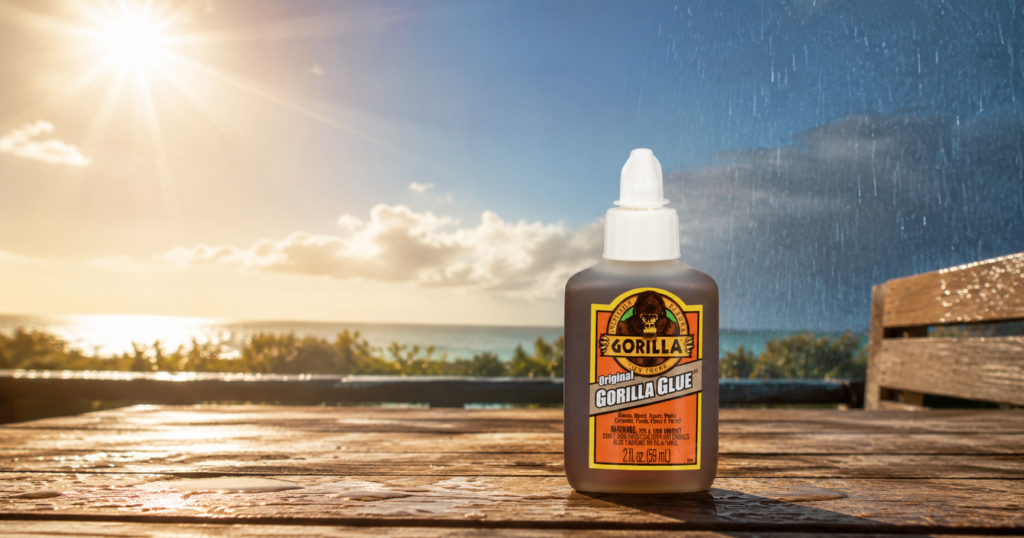
Glue something outside in Australia and you’re not just fighting moisture. You’re fighting 40-degree deck boards in January, a cold snap a few weeks later, UV that chalks paint within a couple of years, and the kind of sudden downpour that catches everyone with washing still on the line. Most adhesives sold in Australia were never tested for that combination, which is exactly why so many outdoor repairs fail within a season. If you want a joint that’s actually built for it, a fully waterproof, temperature-resistant option like Gorilla Glue Original is worth reaching for before you start, rather than after the first repair falls apart.
Why Australian Weather Wrecks Ordinary Glue
Heat is the main culprit, and it works in two directions. Timber and metal expand as they heat up through the day and contract again overnight, and a rigid adhesive that can’t move with the material eventually cracks at the bond line. UV does the quieter damage, breaking down the polymer chains in cheaper glues so the bond turns brittle and chalky, often before you’ve even noticed anything’s wrong. Then rain finishes the job on anything that wasn’t genuinely waterproof to begin with, seeping into hairline gaps and lifting the joint from the inside.
The frustrating part is that a lot of adhesives will look fine on the shelf and even hold for a few weeks. It’s the freeze-thaw-style cycling, hot days followed by cool, damp nights, that exposes the difference between a glue that’s merely water-resistant and one that’s properly weatherproof. That distinction matters more than most people realise.
Water-Resistant and Waterproof Are Not the Same Thing
Water-resistant means a bond can cop the occasional splash without immediately failing. Waterproof means it can sit in standing water indefinitely and still hold. For anything under a gutter, near a downpipe, or on an exposed deck, you need the second one, not the first, and the label rarely spells this out clearly enough.
Polyurethane adhesives are generally the strongest performers outdoors because they cure through a chemical reaction with moisture rather than by simply drying out, and the resulting bond is fully waterproof once cured. They also tend to handle a wider temperature range than standard PVA or contact adhesives, which start softening or losing grip well before you’d expect on a hot Australian afternoon.
What to Actually Look For Before You Buy
Three things matter more than brand loyalty or price. First, genuine waterproofing, not just a “water-resistant” claim buried in fine print. Second, UV and heat stability, since a glue that degrades in sunlight is useless on anything exposed. Third, some flexibility in the cured bond, because timber and metal both move with temperature, and a joint with zero give will eventually crack even if the adhesive itself never lets in water.
Worth keeping in mind: gap-filling ability counts too. Outdoor timber is rarely perfectly flat, especially once it’s weathered a bit, and a glue that expands slightly as it cures will fill small irregularities that a thin, runny adhesive just won’t reach.
Matching the Adhesive to the Job
Garden furniture takes a hammering from both sun and rain, so any glued joint needs to handle constant expansion and contraction as well as full waterproofing. Guttering repairs are trickier again, because you’re often bonding metal to metal or metal to PVC while water sits directly on the join, which rules out anything short of a genuinely waterproof adhesive.
Outdoor timber, decking, fence posts, pergola beams, is usually the most demanding application, since it swells and shrinks with humidity on top of the heat cycling. Letterboxes cop full sun for years without a scrap of shade, so a bond that isn’t UV-stable will fail there faster than almost anywhere else on the property. Deck repairs sit in a category of their own too. If a board’s split or a joist connection has worked loose, you’re relying on that glue to carry actual structural load while sitting exposed to rain, so this isn’t the spot to cut corners with whatever’s already open in the shed.
Getting the Application Right So It Actually Lasts
The trick with polyurethane adhesives is that they need a bit of moisture to kick off curing properly, so a light misting of the surface before application, rather than a dry, dusty joint, makes a real difference to the final bond. Clamp the pieces firmly for the first hour or two while the adhesive expands slightly and cures. Skip the clamping and you’ll likely end up with a weaker, uneven joint, because that early expansion is doing real work to fill gaps and lock the surfaces together.
Always remember to wipe away excess foam before it fully cures, since it hardens quickly and is far easier to sand or trim in that first hour than a day later. And don’t rush the cure time before loading the joint up, even if it feels solid to the touch. Full strength typically takes longer to develop than the surface suggests, so give it the time it needs before you push the tension back onto that repaired chair leg or gutter bracket.
None of this is complicated, but it does mean choosing the right adhesive from the start rather than reaching for whatever’s already open in the shed. Get the waterproofing, UV resistance and flexibility right, and a properly applied outdoor bond will genuinely outlast the next few Australian summers instead of giving up after the first one.