Not every bathroom leak announces itself dramatically.
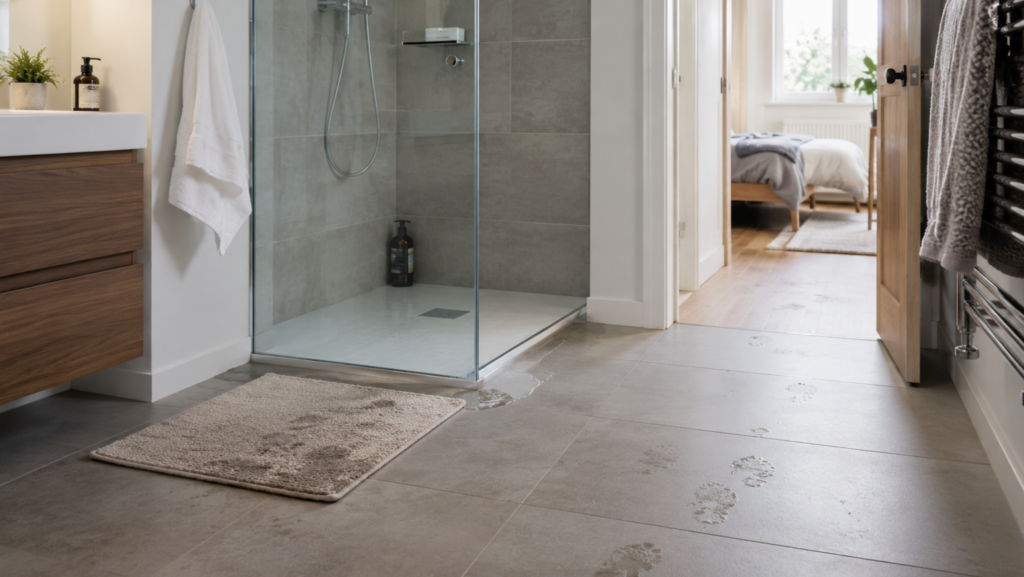
More often, it starts quietly. A patch of water by the shower door. A bath mat that still feels damp the next morning. A line of wet footprints across the hallway after the children have used the shower. In a rental property, it might be a casual message from a tenant: “The shower seems to be leaking a little.”
At first, these things are easy to dismiss. Bathrooms are wet spaces, after all. A little water on the floor can feel like part of daily life. So the mat gets replaced with a thicker one, the floor gets wiped more often, and the problem slowly becomes part of the routine.
But when water keeps appearing in the same place, day after day, it is worth paying attention. That damp patch may not be harmless splashback. It may be a small leak that has simply been hidden by habit.
A bath mat is there to catch wet feet. It should not have to do the job of a shower seal.
When a bath mat becomes a warning sign
Most of us do not think much about the bath mat until it starts to smell.
It is washed, dried, put back down, and then, a few showers later, it feels damp again. Sometimes the bathroom itself begins to take on that faint musty smell, even after it has been cleaned. Towels take longer to dry. The mat starts to look tired sooner than it should.
That is often the moment to stop blaming the mat.
If it is always wet in the same spot, it may be absorbing water that should never have reached the floor in the first place. A thicker mat might hide the problem for a while, but it will not stop water from escaping under a shower door, around a hinge, or from the edge of a glass panel.
There is also the small inconvenience that quickly spreads beyond the bathroom. Someone steps onto the wet patch, walks into the bedroom or hallway, and suddenly there are footprints across the floor. In homes with LVT, laminate or timber flooring nearby, repeated moisture is not something to ignore. It may not cause obvious damage overnight, but water has a way of finding edges, joins and gaps.
By the time flooring starts to lift, skirting boards discolour, or the base of a vanity unit begins to swell, the leak has probably been around for longer than anyone realised.
So the better question is not, “Do I need a better bath mat?”
It is, “Why is the bath mat getting wet every time?”
A shower door should not be expected to leak
It is surprisingly common for people to treat a leaking shower door as normal. After a few years, a damp patch near the door or a wet corner beside the screen can become something everyone simply works around.
Yet a shower door is not meant to leak as part of everyday use. The whole point of seals, profiles and water bars is to help keep water inside the shower area.
If water appears in the same place after every shower, something is usually not quite right. A seal may be worn. It may be missing altogether. It may have been fitted poorly, or it may simply be the wrong type for that particular door.
This is where many homeowners end up replacing the wrong thing. A bottom seal may be bought because the leak is near the floor, when the real problem is at the hinge corner. A generic strip may look similar to the old one, but fail to match the glass thickness or gap size. A vertical seal may be needed between two glass panels, while the person fixing it keeps focusing on the bottom edge.
For anyone unsure about seal profiles, glass thickness or where the water is actually escaping, it can be useful to start with a specialist shower seal supplier rather than guessing from a generic replacement strip. A site such as SIMBA organises seals by position, glass thickness and gap type, which makes it easier to work out whether the issue calls for a bottom seal, side seal, magnetic seal or another water-control option.
That does not mean every small leak needs a complicated solution. Quite the opposite. It means the simplest fix is usually the one that matches the real leak point.
Follow the water before choosing the fix
A wet bathroom floor can look like one problem. In practice, it can have several different causes.
Water along the wall edge often points towards silicone sealant or the wall profile. If the silicone has cracked, lifted or started to pull away from the tiles, water can track along the edge and escape where it should not. Replacing the bottom seal will do very little if the wall joint is the weak point.
Water between two glass doors suggests a different issue. Hinged, folding and sliding shower doors often rely on vertical or magnetic seals to close the gap between panels. If those seals have lost their shape or no longer meet properly, water can pass through the join.
Water under the door usually brings attention back to the bottom seal. A brittle, yellowed, cracked or loose seal may no longer guide water back into the shower tray or bath. Sometimes the seal itself is fine in principle, but the fin is too short, the gap is too large, or the profile is not suited to the screen.
Then there are corner leaks, which can be the most frustrating of all. Water may escape near a hinge, fixed panel or frame where several parts meet. In that situation, the bottom seal may need careful trimming around the corner. In some cases, a threshold strip or water bar may be needed to redirect water back into the shower area.
The route matters. Once you know where the water is coming from, the repair becomes much easier to think about.
Replacing an entire shower enclosure is rarely the first step. More often, the smarter approach is to trace the leak, identify the weak point, and deal with that specific area.
Small bathrooms make moisture harder to ignore
In a compact bathroom, there is nowhere for damp to hide.
Many London flats, converted apartments and small en-suites have the shower, basin, toilet and vanity unit arranged within a very tight space. A little water from the shower door can quickly reach the cabinet. Droplets left on the glass make the room feel dull. A crowded basin area holds moisture around bottles, toothbrush cups and razors. If the extractor fan is weak, the room can stay humid long after the shower has been used.
This is why some bathrooms feel tired even when the fittings are not especially old. The problem is not always the design. Often, it is moisture that has been allowed to linger.
Water marks on the screen, a damp mat, mould in the corner, bottles sitting in small puddles on the basin — none of these things looks serious on its own. Together, they make the whole room feel harder to keep clean.
In a small bathroom, improvement is not always about adding new accessories or redecorating. Sometimes the best upgrade is simply helping the room dry faster. Keep water inside the shower area. Wipe down the glass. Give towels space to dry. Move everyday items off wet surfaces. Make sure ventilation is actually doing its job.
The room may not become larger, but it will feel fresher.
Damp affects the whole room, not just the floor
A leak near the shower is easy to think of as a flooring issue. But repeated moisture changes the atmosphere of a bathroom.
A bath mat that never dries properly begins to smell. Towels can take on a stale odour, even when they are washed regularly. Toothbrush cups and skincare bottles left on a wet basin can trap water underneath. Shampoo and body wash bottles sitting on the shower floor leave rings of soap residue and damp marks.
None of this is dramatic. It is just the slow build-up of moisture in places that never quite dry.
Mould follows the same pattern. When it appears, the instinct is often to reach for a stronger mould remover. Cleaning products have their place, but they do not change the conditions that allowed mould to appear. If the room remains damp after every shower, the same marks are likely to return.
Drying the space matters more than many people realise. A squeegee or towel across the glass after a shower may feel like a small nuisance, but in hard water areas it can reduce limescale, water marks and that cloudy look on the screen. Water on the floor should be guided towards the drain rather than left to evaporate. In a poorly ventilated room, evaporation simply keeps humidity hanging around for longer.
Leaving the shower door or screen slightly open can help air move. A window, even opened briefly, can make a difference. In windowless bathrooms, the extractor fan becomes much more important. Damp towels should not be left in a heap.
These are small habits, but they are often more effective than repeatedly cleaning the same patch of mould every few weeks.
In rentals and holiday lets, small leaks are easy to miss
A small bathroom leak in your own home is inconvenient. In a rental or holiday let, it can quietly become expensive.
Tenants may assume a wet floor after showering is normal and simply use a bath mat. Short-stay guests may notice the problem but never mention it. Cleaners may wipe the floor without knowing whether the water came from a one-off splash or a repeated leak.
By the time the owner spots the pattern, the early signs may have moved on. A swollen floor edge. Darkened silicone. A damp smell inside the vanity unit. A bath mat that seems to need replacing far too often.
This does not necessarily mean anyone has ignored the property. Small leaks are simply easy to miss when the shower still works.
For landlords and holiday let owners, it helps to check the same few places during changeovers or routine maintenance: the bottom of the shower door, hinge corners, fixed panel edges, silicone sealant, tile grout, drainage, extractor fans and the floor beneath the bath mat.
These are ordinary areas, but they are often where repair costs begin. Catch the problem early, and the fix may be a seal, a strip, a small section of silicone or a better drying routine. Leave it too long, and the repair may involve flooring, cabinetry or damp-damaged corners.
Do not let the bath mat make the decision for you
Small leaks rarely look urgent at the beginning.
They look like a damp corner. A wet mat. A faint smell in the towels. A line of water at the bottom of the glass. A few footprints across the hallway.
But if the same sign appears after every shower, it deserves more attention than another quick wipe of the floor.
The answer is not always a new shower enclosure. Nor is it to keep relying on bath mats, towels and cleaning products to disguise the issue. A better starting point is to follow the water. Is it coming from the bottom of the door? From a wall edge? Between two glass panels? Around a hinge? Is the room staying damp because of poor ventilation, cluttered surfaces or towels that never dry?
In many cases, dealing with the problem early may be simple: replace the right small part, add a water bar, refresh a section of silicone, improve ventilation, or build the habit of drying glass and standing water after use.
A bathroom does not need to look brand new forever. It does, however, need to be dry, practical and easy to live with. Good home maintenance is often less about dramatic renovation and more about noticing the small thing before it becomes a bigger one.